
I’ve been thinking lately about the way companies deal with reputation problems, and I think most of them are still using a model that was built for a very different world.
When we think about a corporate crisis, we usually imagine an event. A product fails, customer data gets leaked, an executive says something stupid, or an employee posts something they shouldn’t. The company realizes it has a problem, calls PR and Legal, figures out what happened and eventually responds.
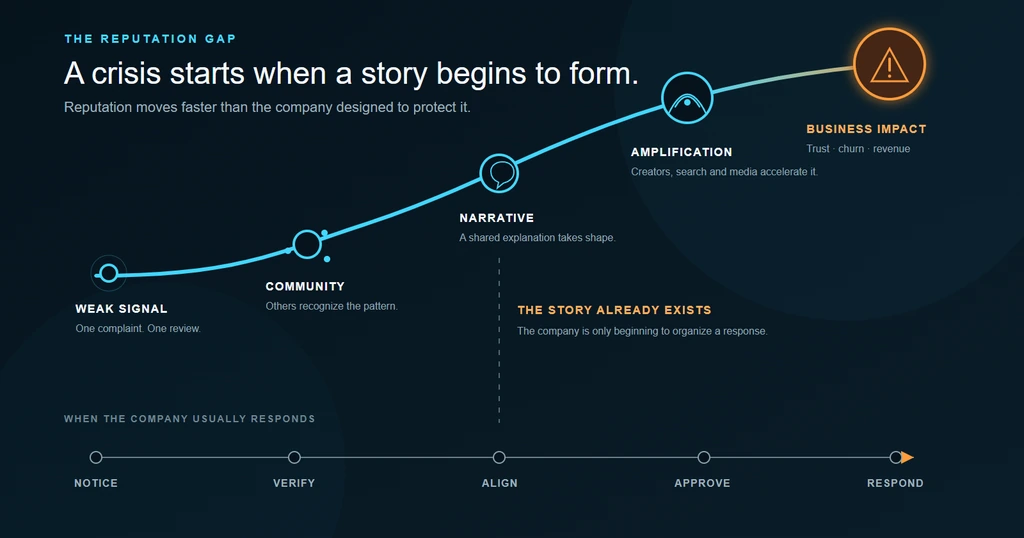
The problem is that today, by the time a company realizes it has a crisis, the most important part may have already happened.
A customer complains on Reddit. A few other people say they’ve had the same problem. Someone makes a video about it, a creator picks it up, Google starts indexing the discussions and eventually the story reaches the media.
The company enters the conversation somewhere near the end.
That’s what changed my way of thinking about this. A crisis doesn’t necessarily start when something bad happens. It starts when a story about your company begins to form.
And those stories can form surprisingly fast.
The internet is faster than your company
Companies are slow for good reasons. You don’t want executives making important decisions based on a tweet they saw five minutes ago.
You need to understand what happened. Legal needs to look at it. Communications needs to decide what to say. Someone needs to approve the response.
The internet doesn’t have any of those constraints.
While you’re having a two-hour meeting, thousands of people can be discussing what happened. By the time your carefully approved statement is ready the next morning, people may have already decided who was right, who was wrong and what your company represents.
Worse, if you don’t provide an explanation, people will create one for you. Silence leaves a hole and the internet is very good at filling holes.
That doesn’t mean companies should react instantly to everything. I actually think that would make things worse. But it does mean that the ability to understand what’s happening quickly has become part of reputation management.
You don’t necessarily need to speak faster. You need to understand faster.
Being right isn’t enough anymore
This is one of the things I find most interesting.
Let’s say somebody makes a false accusation about your company. You investigate and you have everything: emails, data, timestamps, documents. You know exactly what happened and you can prove that you’re right.
You publish the evidence and expect the problem to disappear.
Except it doesn’t.
The mistake is assuming there is only one question: What is true?
There’s another question that may be just as important: Who does the audience trust?
If the CEO says the company did nothing wrong, people know the CEO has an obvious reason to say that. The same applies to the PR department or the company’s lawyers.
Now imagine an independent expert looks at the same evidence and reaches exactly the same conclusion. Or a long-time customer explains why the accusation doesn’t match their experience.
The facts haven’t changed. The credibility of the messenger has.
That’s why I think truth and trust have become two separate problems. A company can win the factual argument and still lose the reputational one.
It also means that some of the most useful relationships a company can have during a crisis need to be built long before the crisis happens. You can’t ignore customers, experts and communities for years and suddenly expect them to trust you when you need them.
Look underneath the anger
Another thing I’ve started paying more attention to is what sits underneath people’s reactions.
Online, we see anger because anger is visible. Angry posts, angry customers, angry employees, angry comments.
But the anger is often covering something else.
Take AI. Someone says AI is destroying their industry. A company might respond by explaining how its technology works, why AI improves productivity or why the technology isn’t as dangerous as people think.
But maybe none of that is what the person is actually worried about.
Maybe what they’re really thinking is: Will I still have a job in five years?
Or: Will the skills I’ve spent 20 years building still be worth anything?
That’s a completely different conversation.
The same thing happens with customers, employees and communities. What looks like anger about a specific decision can actually be fear of losing money, status, control, security or something familiar.
So one question I think is worth asking whenever a group reacts strongly to something a company does is:
What are these people afraid of losing?
Sometimes that tells you much more than reading another thousand angry comments.
Every crisis eventually becomes a story
The internet has an incredible ability to take complicated situations and turn them into simple stories.
Big company versus small customer. Management versus employees. New technology versus an old industry. David versus Goliath.
Before long, somebody is the victim and somebody is the villain.
This creates a strange situation where the public is discussing a story while the company is discussing facts.
The internet says: “This huge company screwed a small customer.”
The company responds with three paragraphs explaining the terms and conditions.
Maybe the company is technically right. But it has brought a contract to a storytelling fight.
I don’t mean companies should manipulate people with stories or ignore the facts. Quite the opposite. But they need to understand the narrative forming around the facts.
If you don’t understand the story people are telling about your company, it’s very difficult to change their minds.
And once you’ve been cast as the villain, everything you say tends to be interpreted through that role.
You may be talking in the wrong place
Companies also tend to communicate where they’re comfortable.
They publish a statement on the corporate website, post something on LinkedIn, maybe send out a press release and consider the job done.
But what if the conversation isn’t happening there?
Maybe it’s happening on Reddit. Maybe it’s YouTube, TikTok, a podcast or a couple of niche newsletters. In some industries, the most important conversation might be happening inside communities most executives don’t even know exist.
This seems obvious, but companies still get it wrong.
There isn’t much value in creating the perfect message if the people you’re trying to reach never see it.
The same applies to who delivers that message. Sometimes the CEO is the right person. Sometimes an engineer, a customer, an employee or an independent expert is far more credible.
The corporate account doesn’t always need to be the loudest voice in the room.
Not all internet outrage matters
This may be the part I think businesses get wrong most often.
Imagine there are 10,000 negative comments about your company. It looks terrible on a dashboard and management understandably starts getting nervous.
But what if almost none of those people are customers? What if they have very little influence over your industry and a week from now they’ve moved on to something else?
Now imagine a different situation. There are no viral posts and no trending hashtags, but ten of your biggest customers quietly tell their account managers that they’re reconsidering their contracts.
The second situation may be infinitely more dangerous.
We’ve become very good at measuring how much people are talking and not nearly as good at measuring whether the conversation actually matters.
I’d want to know who is talking, whether they matter to the business and, most importantly, whether their behavior is changing.
Are customers leaving? Are employees quitting? Are partners becoming nervous? Are regulators paying attention? Is this affecting sales?
Noise and impact are not the same thing.
That also means companies need to become comfortable with something that is surprisingly difficult: doing nothing.
Sometimes responding to a small attack simply gives it attention it didn’t have before. A post with 500 views suddenly becomes news because the company responded to it.
Not every fire needs the corporate fire department.
Some things need a response. Some need to be watched. And some should probably be ignored.
Knowing the difference is the hard part.
AI makes this much more interesting
AI is going to make reputation problems messier.
It’s becoming incredibly cheap to create convincing text, images, audio and video. Fake reviews, fake screenshots and even fake conversations are going to become easier to produce at scale.
But AI also gives companies tools they didn’t have before.
Instead of simply counting brand mentions, imagine a system continuously looking at customer reviews, support tickets, Reddit discussions, news, social media, search trends and industry communities.
The interesting part isn’t sentiment analysis. We’ve had that for years.
The interesting part is whether AI can detect stories that are beginning to form.
Maybe the system notices the same complaint appearing in several unrelated communities. Maybe it sees that a previously insignificant issue is suddenly spreading to actual customers. Maybe it can trace where a claim originated and identify who is amplifying it.
Then it can start asking more useful questions: Is this growing? Who cares about it? Why do they care? Is it changing behavior? What happens if it spreads?
That starts to look like something very different from traditional PR monitoring.
From reputation management to reputation intelligence
Companies have built systems to monitor almost every important part of the business. Sales has its CRM, marketing has analytics, finance has dashboards and cybersecurity has threat detection.
Reputation, on the other hand, is often still handled by a PR team, a few monitoring tools and a crisis plan sitting somewhere in Google Drive.
That feels surprisingly primitive when you think about how quickly a reputation problem can develop today.
I think we’ll eventually see companies build what I’d call a Reputation Intelligence System.
Not another social listening dashboard, but something that continuously tries to understand what is happening around the company.
What stories are starting to form? Where are they coming from? Who is spreading them? Which people actually matter? What’s underneath their reaction? Is perception turning into behavior?
And then the most important question: Should we respond, watch it, or ignore it?
The system would essentially work like a sensor network around the business:
Listen → Detect → Understand → Decide → Respond → Learn.
What would this system actually look like?
I wanted to take the idea a little further and see what a Reputation Intelligence System might look like if it were built as a real product.
So I created a short concept presentation showing the dashboard, the signals it would monitor, the AI agents working behind it and the way it could turn millions of disconnected conversations into something executives can actually use.
It isn’t a finished product or a technical specification. It’s a way of making the idea more concrete.
The presentation explores how such a system could detect emerging narratives, identify the stakeholders who matter, separate online noise from real business impact and recommend whether the company should respond, monitor the situation or leave it alone.
You can download the complete Reputation Intelligence System presentation below.
Download the Reputation Intelligence System presentation (PDF)
The more I think about it, the more reputation starts looking less like a PR problem and more like a business intelligence problem.
Companies probably won’t be able to avoid controversy. If you’re big enough, innovative enough or simply around long enough, something will eventually happen.
The advantage will be seeing it earlier, understanding what actually matters and not confusing a lot of people shouting on the internet with something that can genuinely hurt the business.
Because by the time everyone in the boardroom agrees that you’re in a crisis, there’s a good chance you’ve already been in one for a while.
Leave a Reply