

I started building software around the year 2000, before startup became the default word for every new technology business.
Over the next two decades, I moved through digital publishing, SaaS, e-commerce, gaming, Web3, and artificial intelligence. I built products from scratch, managed distributed teams, sold businesses and digital assets, and shut down projects that did not work. Most of those ventures were self-funded.
For a long time, this made me see capital almost entirely through the founder’s eyes. Money meant time: more time to improve the product, recruit the right people, reach customers, and survive mistakes. The central question seemed simple: What could I build if I had more resources?
Only later did I understand that this is just one side of the table.
An investor can admire a product, respect its founder, believe it will become profitable, and still decide that it is not investable. That decision can feel contradictory until you understand that founders and venture investors are solving different problems.
The founder is building a company. The investor is building a portfolio.
That difference changes almost everything.
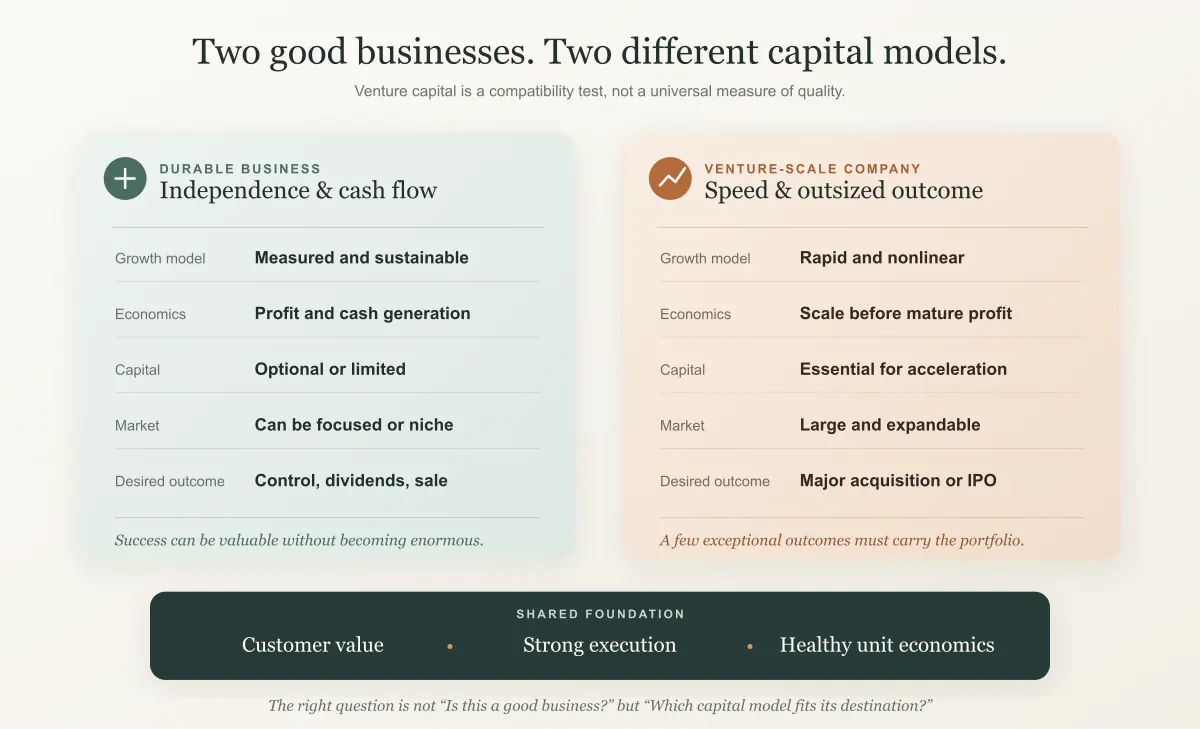
A good company and a venture-backable company are not the same thing
Some of the healthiest businesses will never raise venture capital—and should not.
A company can have loyal customers, predictable revenue, healthy margins, and a capable team, yet remain unsuitable for a venture fund. It may serve a limited market. Its growth may depend on adding people at roughly the same rate as revenue. It may generate excellent cash flow but have no credible path to a very large exit.
None of those characteristics makes it a bad business. They simply make it incompatible with the mathematics of venture capital.
A venture fund expects many investments to fail, stall, or return only a modest amount. The few exceptional outcomes must therefore compensate for all the others. An investable company does not merely need a plausible path to success. It needs a plausible path to becoming large enough to matter inside a portfolio.
This was one of the most important distinctions for me to absorb. Entrepreneurs are often taught to treat fundraising as validation. If investors are interested, the company must be valuable; if they are not, something must be wrong.
Reality is more nuanced. Venture capital is not a universal score for business quality. It is one specific financial instrument designed for one specific pattern of risk and return.
A profitable niche business may be a better outcome for its founder than a venture-backed company forced to pursue an unnatural scale. Conversely, a capital-intensive technology business may be impossible to build through cash flow alone, even when the founder values independence.
The relevant question is not, Can this company raise money?
It is, What kind of company are we trying to build, and what kind of capital is compatible with that destination?
The same company, seen through two lenses
For the founder, the company is an all-encompassing reality. It contains years of work, personal risk, relationships, identity, and unfinished possibility. A founder naturally asks:
- Can we build a product customers genuinely need?
- Can we find enough time and money to reach the next stage?
- Can we create a team capable of carrying the idea further?
- Can the company survive long enough to find its place in the market?
The venture investor must ask a different set of questions:
- How large can this company become?
- Can it produce a meaningful return relative to the size of our fund?
- What ownership can we obtain and preserve?
- What must be true for a large exit to become possible?
- Is this opportunity stronger than the other uses of our time and capital?
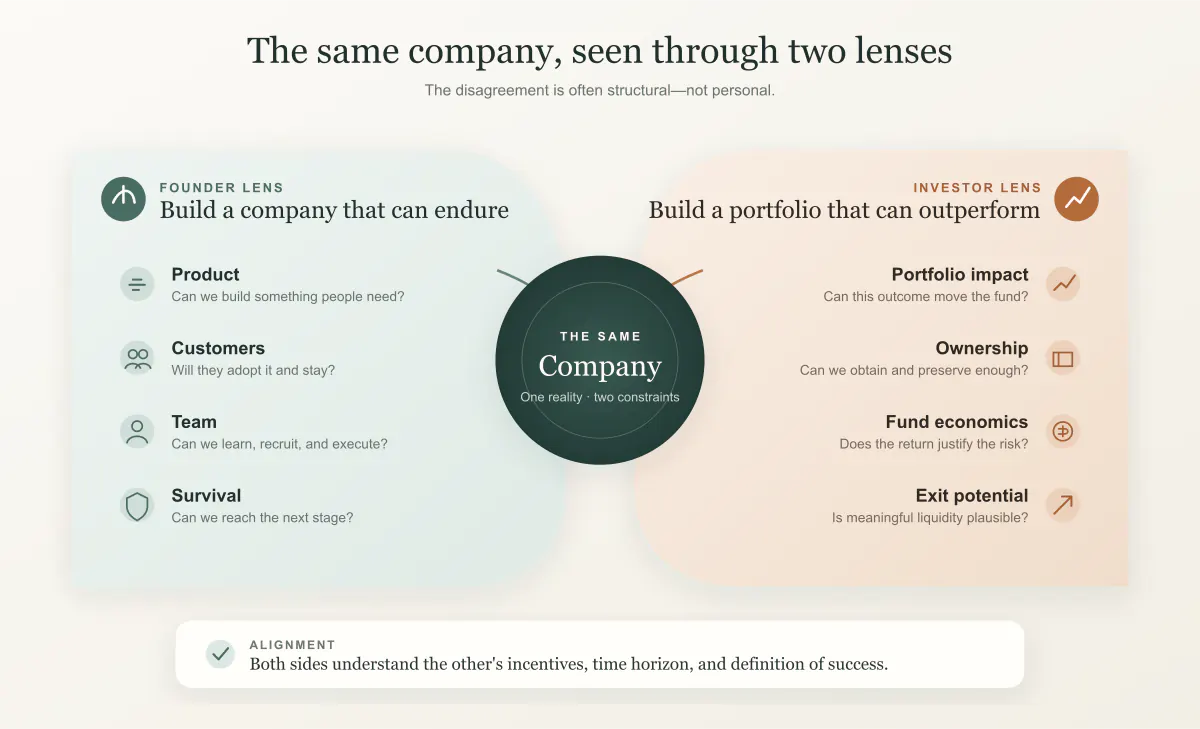
Neither perspective is inherently more intelligent or more legitimate. The conflict comes from pretending they are identical.
When a founder says, “This can become a successful €50 million company,” the statement may describe an extraordinary entrepreneurial outcome. To a large fund, however, the same outcome may have little effect on total returns. A smaller fund might find it transformative.
This is why the size of the investor matters almost as much as the amount being raised. Fund size shapes check size, ownership targets, follow-on strategy, and the minimum exit that can move the needle. An investor may genuinely like a company and still be structurally unable to invest in it.
Rejection is not always a verdict on the founder. Sometimes it is simply a mismatch between two economic models.
Capital comes with a destination
Founders often describe capital as fuel. The metaphor is useful, but incomplete. Fuel does not merely help a vehicle move faster; it assumes that the vehicle is supposed to travel toward a particular destination.
Venture capital normally brings an expectation of rapid growth, repeated financing, increasing organizational complexity, and eventual liquidity. It also brings dilution, governance rights, reporting obligations, and pressure to pursue a result that matters at fund scale.
That can be exactly what a company needs. Capital can compress years of product development, allow a company to recruit talent before revenue can support it, and help it capture a market during a narrow window of opportunity.
But capital can also amplify confusion.
If distribution is weak, more money can hide the problem temporarily. If unit economics do not work, growth can multiply losses. If the market is smaller than expected, capital can push a company to manufacture a scale that does not exist. If the founders are not aligned, financing can increase the stakes without resolving the conflict.
Money does not create clarity. It increases the consequences of whatever is already there.
Having bootstrapped most of my ventures, I know both the freedom and the constraints of self-funding. It forces prioritization. It keeps the feedback loop close to the customer. It also limits speed, makes certain technical bets difficult, and can leave a company under-resourced precisely when a market begins to open.
I no longer see bootstrapping as a badge of moral superiority, just as I do not see fundraising as proof of success. They are different tools for different company trajectories.
What TechCrunch Disrupt taught me about investor interest
In 2021, Emoter—an emotional-intelligence dating product I had founded—was selected for TechCrunch Disrupt from a field of almost 400 startups.
I had built the concept around psychological ideas such as attachment and transference, translating them into a matching system and a digital experience. At the event, I pitched Emoter to several investors, including representatives of Sequoia Capital, who expressed interest in the concept.
It was an important moment. It was also a lesson in the distance between attracting attention and becoming an investment.
A compelling idea can open a door. It cannot do the work that comes after the door opens.
Investor interest is not the same as conviction. Conviction is not the same as a term sheet. A term sheet is not the same as money in the bank. And money in the bank is certainly not the same as a successful company.
Behind every promising pitch sits a much harder chain of questions. Is the market ready now? Can the product reach customers at scale? Can the team recruit the people it will need? Is there a durable advantage? Can the company absorb capital intelligently? Will another investor be willing to finance the next stage?
That experience helped me understand that a pitch is not a compressed description of the product. It is an argument about a future.
The founder is asking the investor to believe that a sequence of uncertain transitions can occur:
Product → adoption → distribution → revenue → defensibility → scale → liquidity
The investor’s task is not to decide whether that future is certain. Nothing meaningful at an early stage is certain. The task is to decide whether the assumptions are coherent, whether the upside is large enough, and whether this particular team has a credible chance of navigating what cannot yet be known.
Investors finance trajectories, not products
Founders naturally spend most of their pitch talking about the product. It is what we have built, what we can demonstrate, and what we know most intimately.
But a product is only one component of a company.
A technically impressive product can fail because distribution is too expensive. A beloved product can exist in a market too small to support the expected outcome. A fast-growing company can discover that every new customer makes its economics worse. A first mover can educate the market only to be overtaken by a better-capitalized competitor.
Investors therefore look beyond what exists. They try to understand the trajectory that might connect today’s evidence to tomorrow’s scale.
Across the products I have built, I have repeatedly seen how easy it is to confuse a compelling feature with a company. A feature solves a visible problem. A company also needs distribution, repeatable demand, sound economics, and a position that becomes stronger as the market develops.
The first can create interest. The second creates a possible company trajectory.
That distinction should not become an excuse for grandiose storytelling. A large vision without a credible sequence of steps is theatre. The purpose of the trajectory is to connect ambition to evidence: who buys, why they buy now, how the product reaches them, why they stay, and how the business becomes stronger as it grows.
Due diligence does not remove uncertainty
Founders sometimes experience due diligence as an examination in which the investor has the correct answers. In early-stage investing, nobody has the answer key.
The future market does not yet exist in a form that can be measured precisely. Revenue forecasts depend on assumptions about behavior, pricing, distribution, competition, hiring, and capital availability. A spreadsheet can make those assumptions look exact without making them true.
Good diligence does something more modest and more useful: it organizes uncertainty.
It separates ordinary early-stage risk from fatal risk. It identifies which beliefs can be tested, which weaknesses can be corrected, and which unknowns could invalidate the entire opportunity. It also tests the founder’s relationship with reality.
At an early stage, I would not expect a founder to know everything. I would want to know whether the founder understands the decisive questions, can distinguish evidence from hope, and changes course when reality contradicts the original model.
In a startup, the original idea will evolve, the product may need to be rebuilt, and the market can move without warning. The strongest teams do not avoid these changes; they learn faster than the assumptions behind the business become obsolete.
Terms define power, not only price
Founders tend to focus on valuation because it is visible, comparable, and emotionally charged. A higher valuation feels like a stronger confirmation of what has been built.
Yet valuation is only the entry price. The investment documents also determine how power and outcomes will be divided.
They can affect board control, voting rights, future dilution, founder vesting, liquidation preferences, participation in later rounds, and who receives money first in an exit. Two offers with the same headline valuation can produce very different outcomes for the founders.
A valuation that is too high can also become a burden. If the company cannot grow into it before the next financing, the founders may face a down round, heavier dilution, damaged morale, or terms designed to protect new investors from the previous price.
The best deal is not necessarily the one with the largest number at the top. It is the one whose capital, expectations, governance, and partners remain coherent when the company enters a difficult period.
Pitch meetings are short. Investor relationships can last a decade.
Paper value and real liquidity
The startup world talks easily about valuations. Liquidity receives less attention.
A stake can be worth millions on paper and produce no usable money for years. The company may never exit. A later financing may reduce its valuation. Preference terms may change how proceeds are distributed. There may simply be no buyer when an investor or founder wants to sell.
This is why professional investors distinguish between estimated portfolio value and money actually returned. The distinction has an entrepreneurial equivalent: revenue, profit, valuation, and cash are four different realities.
I have sold businesses and digital assets, and those experiences made the difference tangible. Before a transaction closes, value is an argument. After the proceeds arrive, value becomes a fact.
This does not mean paper value is meaningless. It means we should not confuse a temporary market opinion with a completed outcome.
Access comes before selection
The popular image of venture capital is an investor calmly selecting the best companies from the entire market. In practice, no investor sees every opportunity.
The ability to choose begins with access: relationships with founders, technical communities, operators, other investors, universities, and industries undergoing change. The strongest opportunities may never enter an open application process. By the time a company is obviously exceptional, competition for allocation can be intense.
The same principle applies to founders. Building something valuable is necessary, but it is not always sufficient. The company must enter the networks in which its value can be noticed, interpreted, and supported.
This is not a comfortable idea for builders who would prefer the product to speak entirely for itself. I have often shared that instinct. But products do not speak. People create the contexts in which products become legible.
Relationships cannot rescue a weak company. They can ensure that a strong one gets seen.
Luck is real, but it is not a strategy
Timing has shaped every technology cycle I have worked through. A product can be too early, not merely wrong. A regulatory change can open or close a market. A platform can change its rules. A competitor can raise more money. A chance conversation can lead to a decisive colleague, customer, or investor.
Acknowledging luck does not diminish competence.
Competence improves the quality of opportunities we encounter. It helps us recognize signals, learn faster, preserve resources, build trust, and remain alive long enough for a favorable moment to matter.
We cannot manufacture luck. We can increase the surface area on which it can land.
The questions I ask now
After more than two decades of building companies, I no longer view capital as validation. Nor do I treat independence as an absolute virtue.
Before pursuing venture funding, I would ask:
- Does this company genuinely need venture capital?
- Can the market support an outcome large enough for the kind of fund we are approaching?
- Will capital accelerate a promising mechanism, or merely conceal the absence of one?
- Are we prepared for dilution, governance, external expectations, and repeated fundraising?
- Do we want these investors beside us when performance falls below the plan?
- Are we building a large company, or simply a story that sounds large in a pitch?
- What version of this business could we build without venture capital?
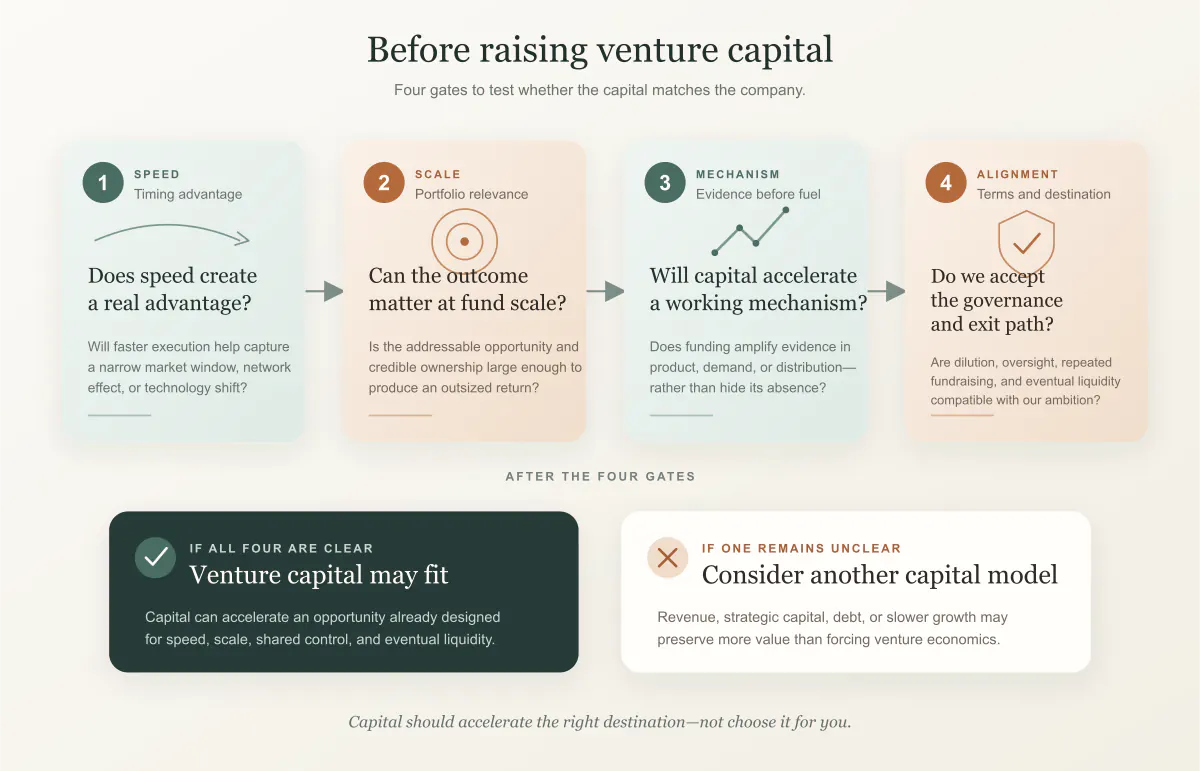
These questions do not produce a universal answer. They produce alignment.
Capital amplifies what is already there
Venture capital can accelerate a company dramatically. It cannot substitute for clarity, distribution, product quality, or the ability to execute.
Capital amplifies.
When the underlying mechanism is healthy, it can help turn a narrow opening into a global company. When the foundation is fragile, it can accelerate spending, premature hiring, and the distance between the story and reality.
I have come to see venture capital as a discipline of judgment under uncertainty. Money is the raw material, but outcomes depend on people, access, timing, ownership, governance, and the ability to remain intellectually honest while the evidence is incomplete.
The founder and the investor do not need to see the world in the same way.
But they need to understand the game they have decided to play together.
Leave a Reply