

Most conversations about AI in business start with the tools. Which model should you use? Which tasks can you automate? How many agents can you connect before the whole thing begins to run by itself? I understand the appeal, but I think these questions often arrive before a more useful one: what are customers actually paying you for?
A business owner looking for more qualified sales conversations still wants more qualified sales conversations. Someone hiring an agency to improve their marketing still wants a clearer message, better distribution, and a reason for customers to choose them. AI can change how that work gets done. The commercial problem remains familiar.
This is the distinction I keep coming back to when thinking about AI and service businesses. The opportunity is easy to misunderstand if we focus entirely on what the technology can produce. It becomes more interesting when we look at the company built around it.
The service was never the deliverable
Agencies often describe their work through deliverables: twelve social posts, four newsletters, a landing page, a monthly report. These are useful for defining scope, but they can also obscure the reason the client hired the agency in the first place. Nobody opens a business because they have always wanted a monthly marketing report.
The report helps someone understand what is happening. The landing page helps turn attention into enquiries. The newsletter might build trust with people who are not ready to buy yet. Each deliverable has value because of the role it plays in a larger process.
AI makes this distinction harder to ignore. When a first draft becomes easier to produce, clients have more reason to question what they are paying for. An agency needs a convincing answer about its contribution beyond the volume of material it creates.
The old agency model
A traditional agency tends to grow by adding people. More clients create more research, writing, reporting, coordination, and account management. Eventually, the founder hires someone to manage the people doing the work, then someone else to manage the relationship with the client.
There are good reasons for this structure. Service businesses depend on judgment, relationships, and work that does not always fit neatly into a process. But they also accumulate repetitive tasks and handoffs that consume time without improving the result very much.
AI creates an opportunity to revisit that structure. A smaller team may be able to serve more clients if parts of the research, preparation, and reporting are handled reliably by software. Whether that translates into a better business depends on the cost of checking the work, maintaining the system, and correcting its mistakes.
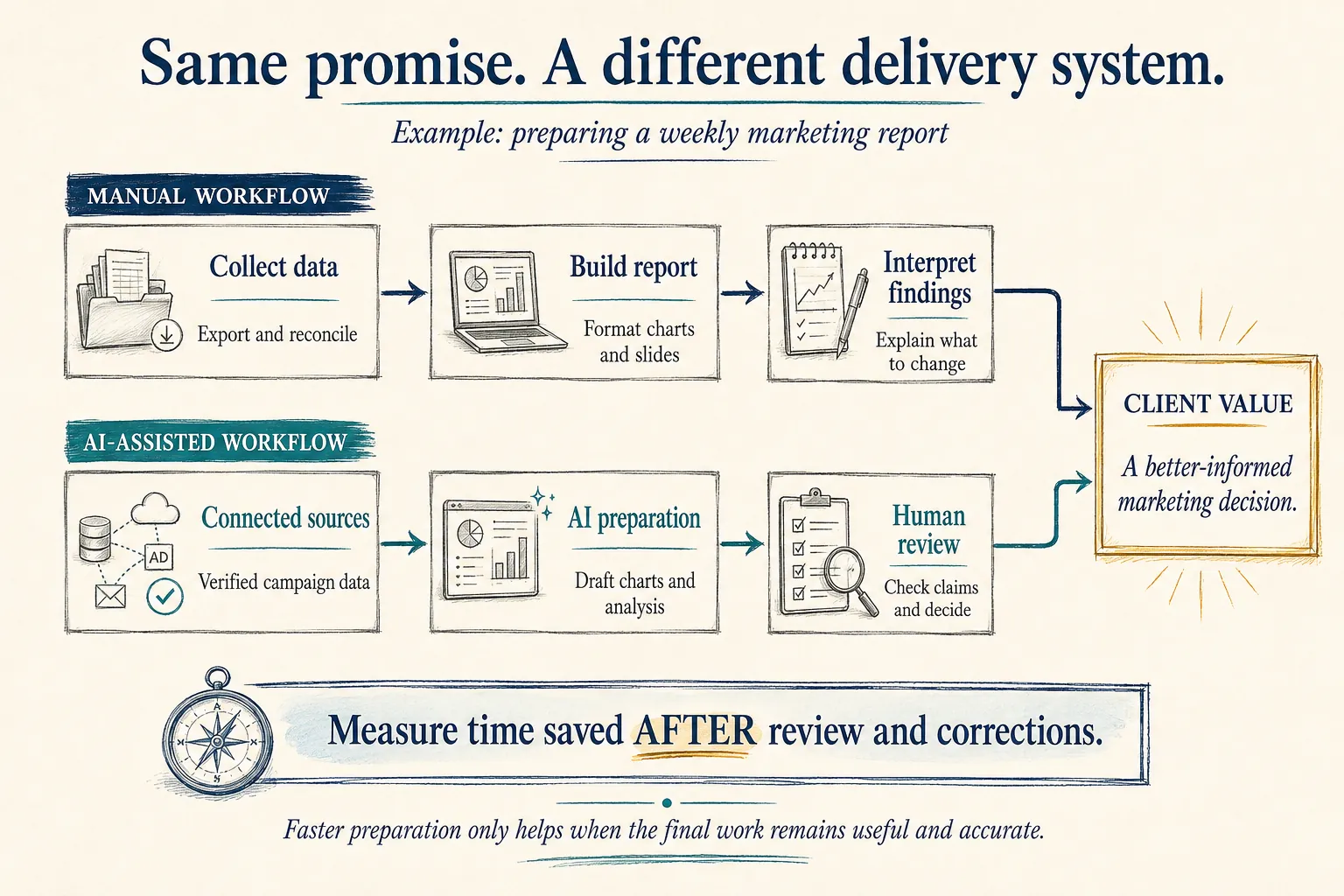
The new model is not selling AI
Imagine two agencies approaching the same company. One offers an AI-powered outreach system with automated research and personalised messages. The other offers to help the company reach a specific type of buyer and create more relevant sales conversations. The first explains its machinery. The second gives the buyer a business proposition to evaluate.
The technology can still matter in the buying decision. A client may care about speed, data handling, reliability, or how much involvement the service requires from their team. But those details become useful when they explain how the service will work and why the agency can deliver it well.
I would build the offer around a problem I understand, for a customer I can identify, with a result I can measure responsibly. Then I would use AI wherever it improves delivery. That order makes the business easier to explain and gives the technology a clear purpose.
A chatbot answers. An agent does work.
There is a practical difference between asking a chatbot to write an email and building a workflow that prepares the information needed to write a useful one. In the first case, you are still gathering the context, moving it between tools, and deciding what happens next. The model helps with one task inside a process you continue to operate.
An agent can take on several connected steps, within the tools and permissions it has been given. It might review a company website, extract relevant information, compare it with a target customer profile, and prepare a draft for approval. That makes it useful for a different kind of work, although it also introduces more places where an error can travel downstream.
The important question is how much responsibility the workflow can handle reliably. Clear instructions, suitable source material, and a defined point for human review matter more than giving the system an impressive name.
The important chain is source to client
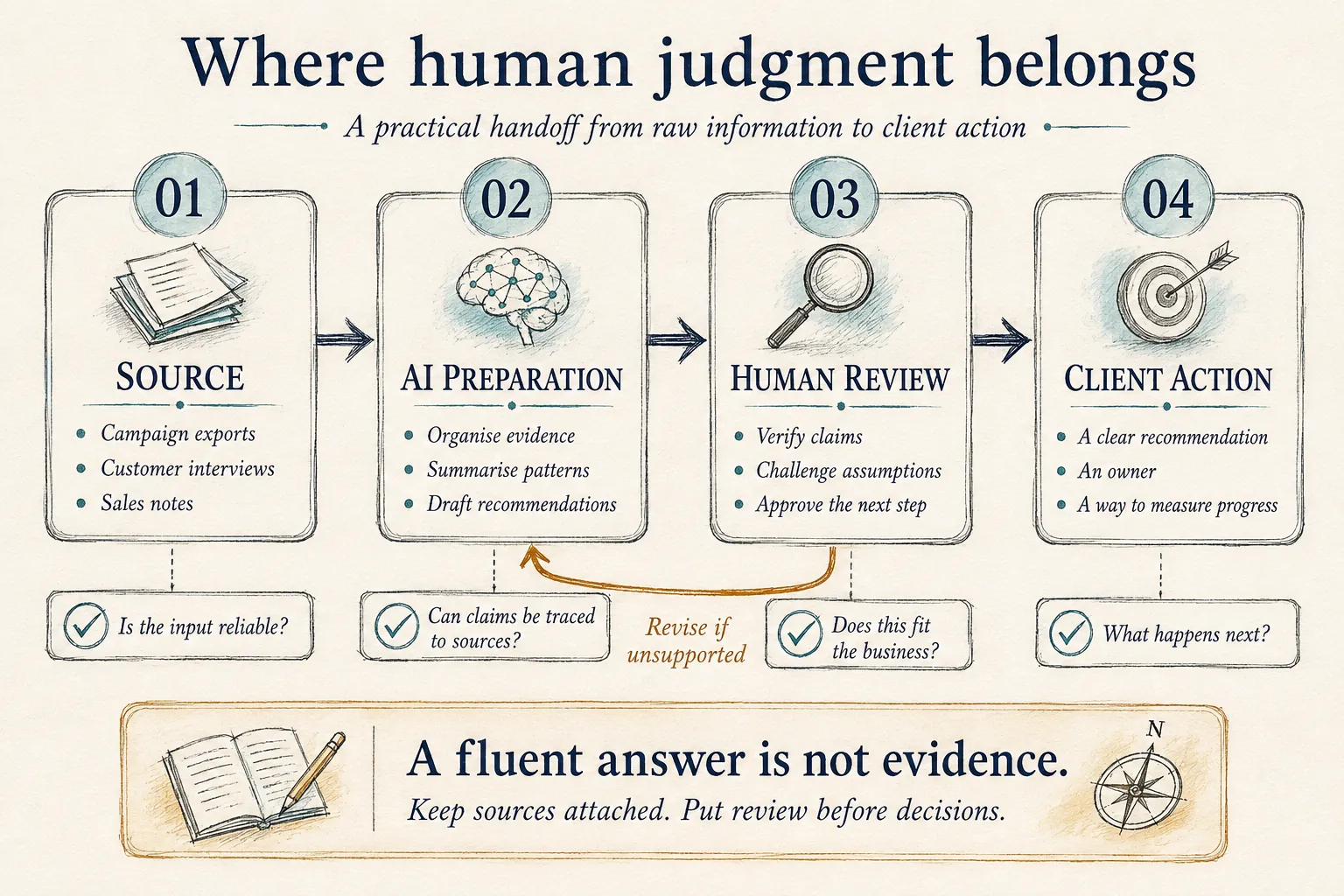
I find it helpful to think about delivery as a chain: source, agent, human, client. The source contains the material the work depends on, such as interview notes, customer conversations, campaign data, or a prospect’s website. The agent processes that material, and a person checks what it means before it becomes something the client relies on.
Each stage has its own responsibility. Good source material gives the system something useful to work with. The agent handles defined tasks, while the person checks accuracy, context, and whether the output serves the objective. The client receives work that has passed through those checks.
For a marketing report, that could mean collecting verified campaign data, generating an initial analysis, and having a strategist investigate the conclusions before presenting recommendations. The time saved on preparation creates room for interpretation, provided someone actually uses it that way.
Do not automate a process that should disappear
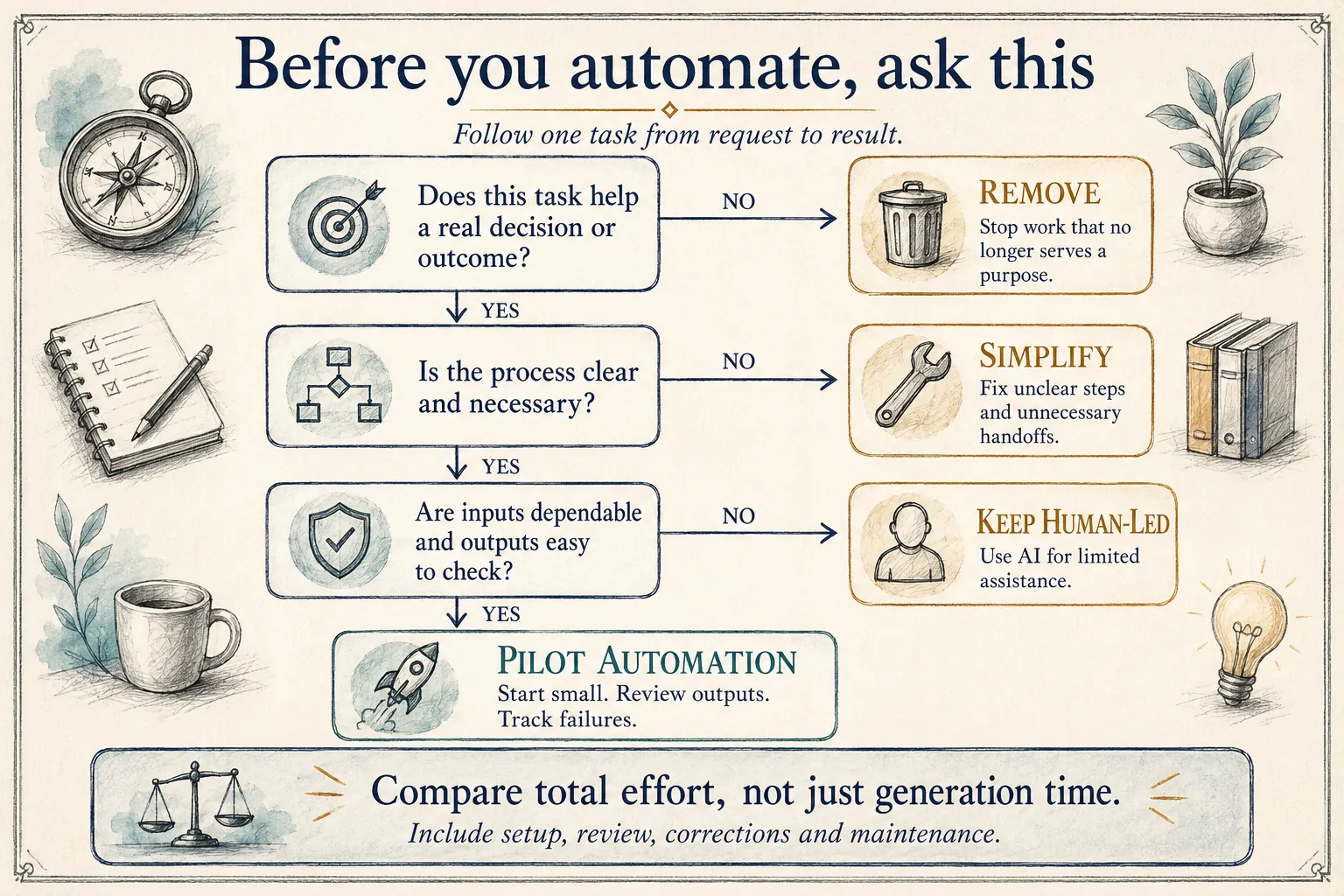
Before building an automation, I would look at why the task exists. Businesses carry around plenty of work that made sense at one point and was never questioned again. A spreadsheet gets updated because someone once asked for it. A report gets sent every Friday even though nobody uses it to make a decision.
Automating that work can make it cheaper, but removing it may be more useful. The same applies to processes with too many approvals or information copied across several systems. It is worth simplifying the route before making each step faster.
A practical starting point is to follow one piece of work from the client’s request to the finished result. Note where people wait, repeat themselves, search for information, or correct earlier mistakes. That gives you a much better basis for deciding where AI belongs.
The value of a service moves upwards
As production becomes easier, more of an agency’s value may sit in choosing what should be produced and making sure it works in context. Generating ten advertising concepts is useful. Understanding which customer concern deserves attention, and designing a sensible way to test the message, requires a different level of judgment.
This does not make execution irrelevant. Someone still has to turn a strategy into work that is accurate, clear, and suitable for the audience. It does mean that an agency whose only distinction is its ability to produce material quickly may find that advantage difficult to defend.
The stronger position is to understand how the pieces connect. Research informs the offer, the offer shapes the message, and the message needs to fit both the channel and the sales process. AI can assist across that chain, but somebody has to take responsibility for its coherence.
AI changes the shape of a small company
A small agency might organise itself around a founder who owns the commercial direction, a specialist who reviews the work, and a set of workflows that handle preparation and recurring tasks. That could give it more capacity without immediately requiring another layer of management. It also changes what the team needs to be good at.
Someone has to maintain the instructions, manage access to client information, and notice when a workflow stops behaving as expected. The work does not simply vanish. Some of it moves from producing individual outputs to maintaining the conditions under which good outputs can be produced consistently.
That trade can be attractive when a service has repeatable parts. It becomes less straightforward when every client requires a completely different approach. The business still needs enough consistency to benefit from its systems and enough flexibility to handle the situations those systems do not cover.
But AI cannot fix a weak offer
A faster delivery process does little for a service that customers do not particularly want. If the problem is unimportant, the promise is vague, or the buyer cannot justify the cost, adding AI does not resolve the commercial weakness. It may simply let the agency produce unwanted work more efficiently.
This is why choosing the customer and understanding their economics comes first. What happens when the problem remains unresolved? What would an improvement be worth? Can the agency influence that improvement, and can it distinguish its contribution from other factors?
These questions also help keep promises realistic. An agency can control the quality of its research, the work it delivers, and the process it follows. It usually has less control over a client’s pricing, sales team, capacity, or market conditions. A good offer recognises those dependencies.
The real advantage is not the tool
A tool available to every competitor is a useful capability, but a fragile point of differentiation. The more durable advantage may come from what an agency learns through repeated work: which objections appear in a market, what information clients consistently lack, and where campaigns tend to break down.
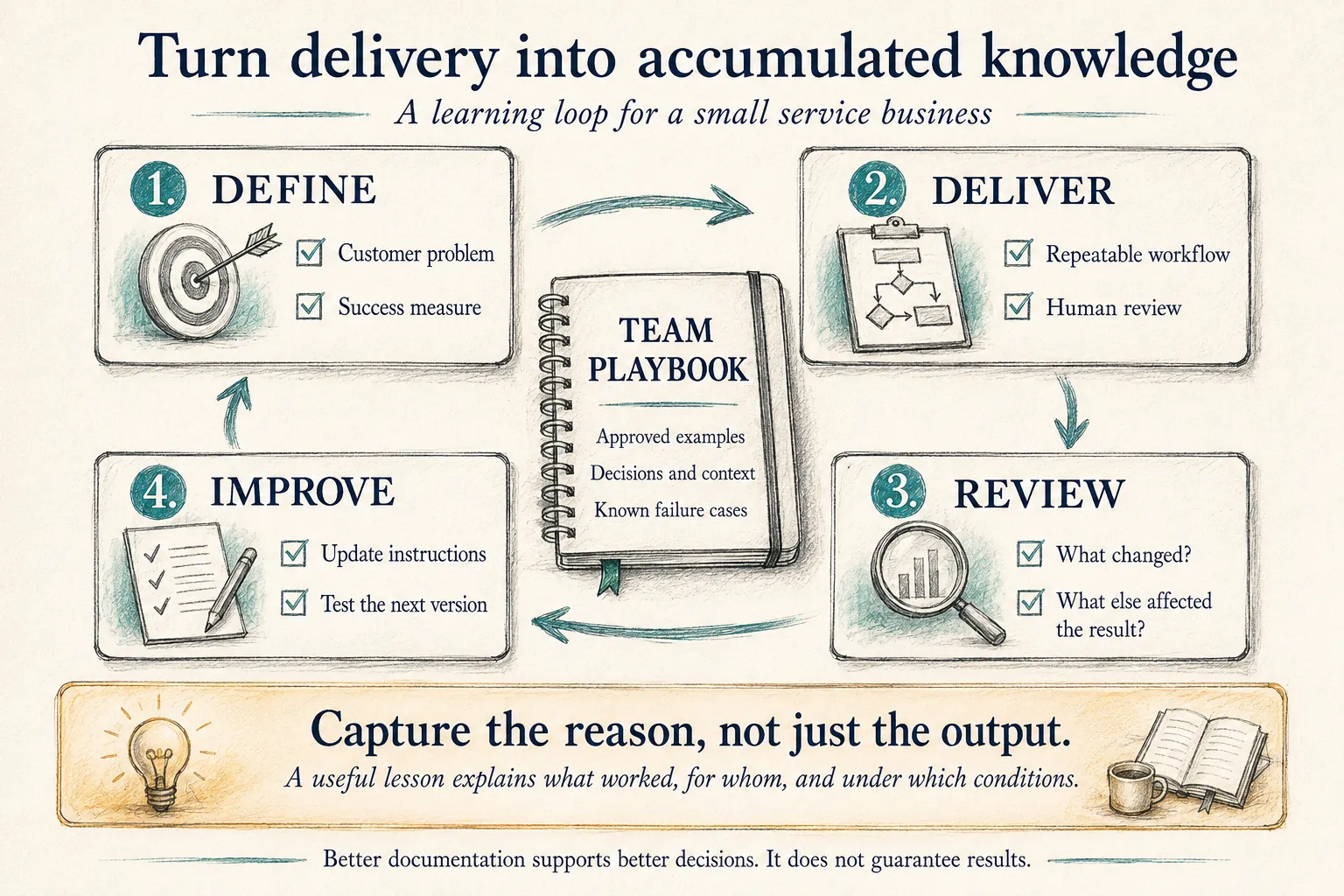
That knowledge becomes more valuable when it is captured and used. Approved examples, documented decisions, and lessons from previous projects can improve future work. A knowledge base earns its place when it helps the team make better decisions, rather than becoming another folder nobody opens.
The result is a learning loop. The agency makes a promise, delivers the service, reviews what happened, and adjusts its approach. AI can help organise and apply those lessons, while people remain responsible for deciding which conclusions the evidence actually supports.
A different way to think about agencies
What interests me about AI in service businesses is the possibility of building a company with more room for judgment. If research preparation, routine coordination, and first drafts take less effort, a team can spend more time understanding the client and deciding what deserves to happen next. That is a meaningful improvement if it shows up in the quality of the service.
It requires looking beyond the individual tool. The offer, the workflow, the review process, and the way the company learns all need to fit together. Otherwise, the agency has added technology without necessarily becoming more useful.
I would start with a customer problem worth solving and work backwards through the delivery. Where does the work need human attention? Which steps can become simpler? What could a small team deliver consistently with a better system? Those questions give AI a practical role in the business—and give the client a reason to care.
Leave a Reply