

A company may already have the knowledge needed for its next business opportunity. The difficulty is bringing the right pieces together.
An engineer understands why an earlier project failed. A sales team keeps hearing the same customer complaint. A supplier introduces a technology that changes what is possible. Each piece matters, but the connection between them may go unnoticed.
This is the problem behind CONCLAVE, a concept I developed to explore how AI agents could help companies connect knowledge, identify opportunities, and prepare decisions people can examine and act on.
Why I developed the concept
What interests me is how much useful knowledge a company already has but struggles to connect. A past project, a recurring customer problem, and a new technology may together suggest an opportunity that no team can see on its own.
I believe every company should have a practical way to investigate those connections, adapted to its size and needs. CONCLAVE is my proposal for organizing that work.
Imagine a manufacturer that abandoned a product because a component was too expensive. Two years later, a supplier introduces a different production process. The original research may now deserve another look, provided someone connects the new development to the earlier decision.
A service business could face a similar situation. Support and sales teams repeatedly encounter the same customer problem, while another team has already developed an internal solution. Connecting that knowledge could reveal an offering worth testing.
From a connection to a testable opportunity
CONCLAVE would begin with a business question and relevant internal information: capabilities, previous projects, customer feedback, and operational constraints. AI agents would investigate external developments and examine how they relate to that context.
A promising connection would become a proposal with supporting evidence, visible assumptions, and a practical next step.
There is a useful precedent for linking AI-generated ideas to evaluation. Google DeepMind’s FunSearch paired a language model with an automated evaluator and produced new mathematical constructions that improved known results for the cap set problem in some settings. The model proposed programs; the evaluator tested them. Read the original FunSearch explanation.
Business decisions rarely have such precise tests. They require experiments, expert judgment, and an understanding of people. CONCLAVE applies that principle of generating and checking ideas to a proposed business workflow.
Why CONCLAVE
The name draws on the papal conclave, where cardinals gather in seclusion to elect a pope. The Latin origin, cum clave, means “with a key.” Vatican News explains its history.
For me, the connection is a focused gathering of perspectives around an important decision. In this concept, the evidence and objections would remain available for people to inspect.
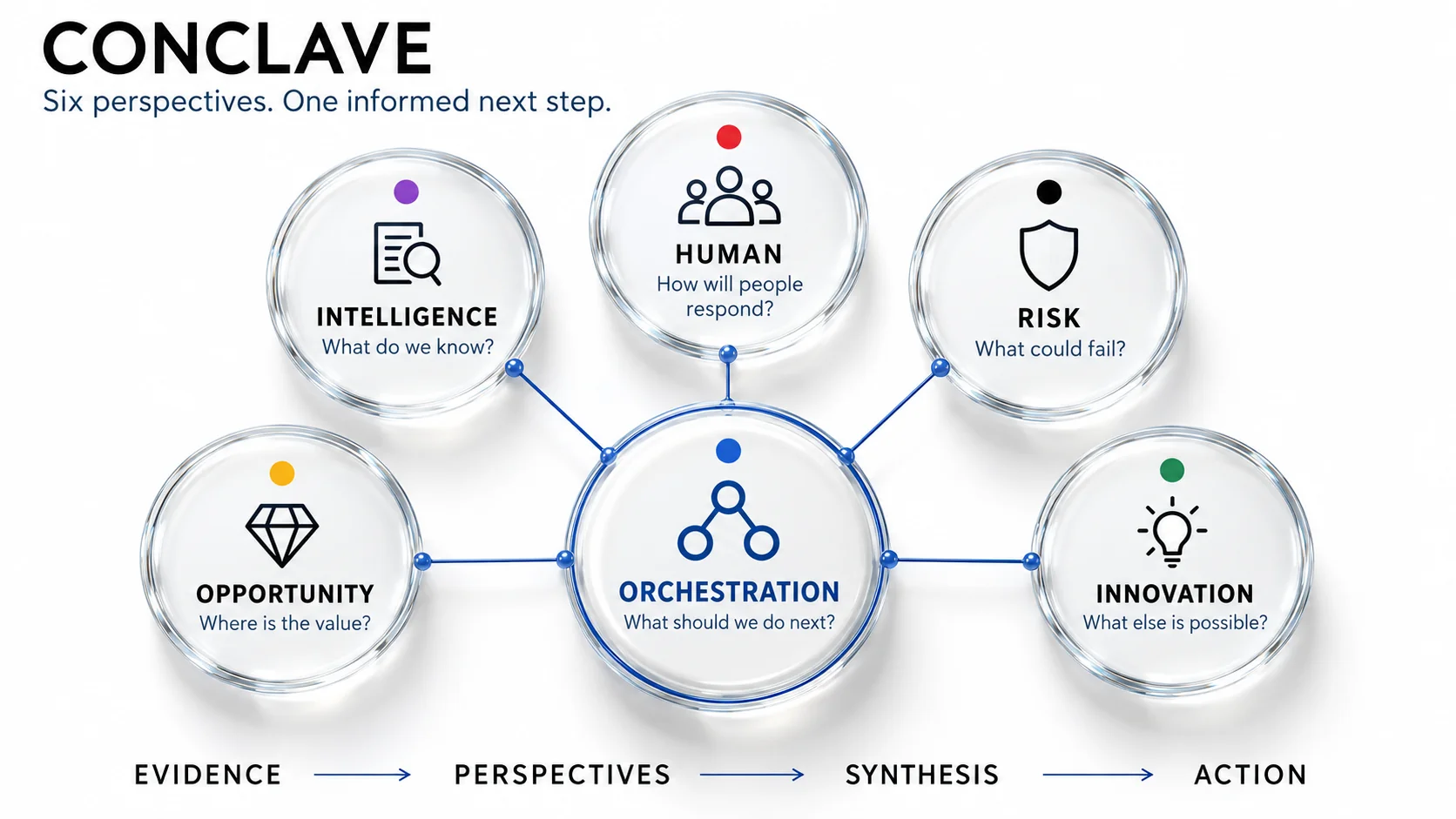
The proposed council combines Intelligence to examine evidence, Human to consider people and adoption, Risk to investigate potential failures, Opportunity to assess value, Innovation to explore alternatives, and Orchestration to bring the findings together.
Different agent roles do not automatically produce independent judgment. Their conclusions would still need verification and human review. A serious objection must remain visible, even when other perspectives favor the proposal.
Explore the concept through VITALIS
The presentation below illustrates CONCLAVE through VITALIS, a hypothetical medical diagnostics opportunity.
The scenario connects existing sensor and assay capabilities with a possible printed sensor format and a need for repeated testing at home. It explores how that connection could become a product hypothesis, then a proposal for controlled feasibility work.
The important questions concern what must be learned: can the assays transfer successfully, can the product be manufactured reliably, and can intended users complete the critical tasks?
This is a concept presentation. The interfaces, product visualization, and case estimates illustrate how the system could work. They do not represent a deployed platform or a validated medical product.
Explore the 12-slide concept presentation at your own pace. Select Full screen to read the details more comfortably.
Loading presentation…
What would make it useful
I would judge CONCLAVE by whether it helps a company make better decisions. Did it reveal a relevant connection? Did it expose an assumption before a large investment? Did it help the team design a test that resolved an important uncertainty?
An early decision to stop could be valuable. So could preserving the reasons behind a decision, allowing someone to revisit it when circumstances change.
A practical starting point would be one business question, a limited set of sources, and a person accountable for the outcome. The team could investigate one hypothesis and agree what evidence would justify continuing, revising, or stopping.
Could this work in your company?
Through MyRemote.Team, I build and manage dedicated remote tech teams for startups and growing businesses. I can help bring together the team to develop a system like CONCLAVE around your company’s knowledge, workflows, and business priorities.
We would start with a specific business question, identify the relevant information, and define a focused pilot. That would give us a practical way to test the approach before deciding whether to expand it.
If your company has valuable knowledge spread across teams and systems, let’s discuss what connecting it could make possible.
Leave a Reply