
I’ve been in online business for a long time, and one thing has become increasingly obvious:
Most marketing looks the same.
Businesses study what works, copy it, optimize it and repeat it. Eventually, every website, advertisement, email and sales funnel starts to feel familiar.
The problem is that familiar is easy to ignore.
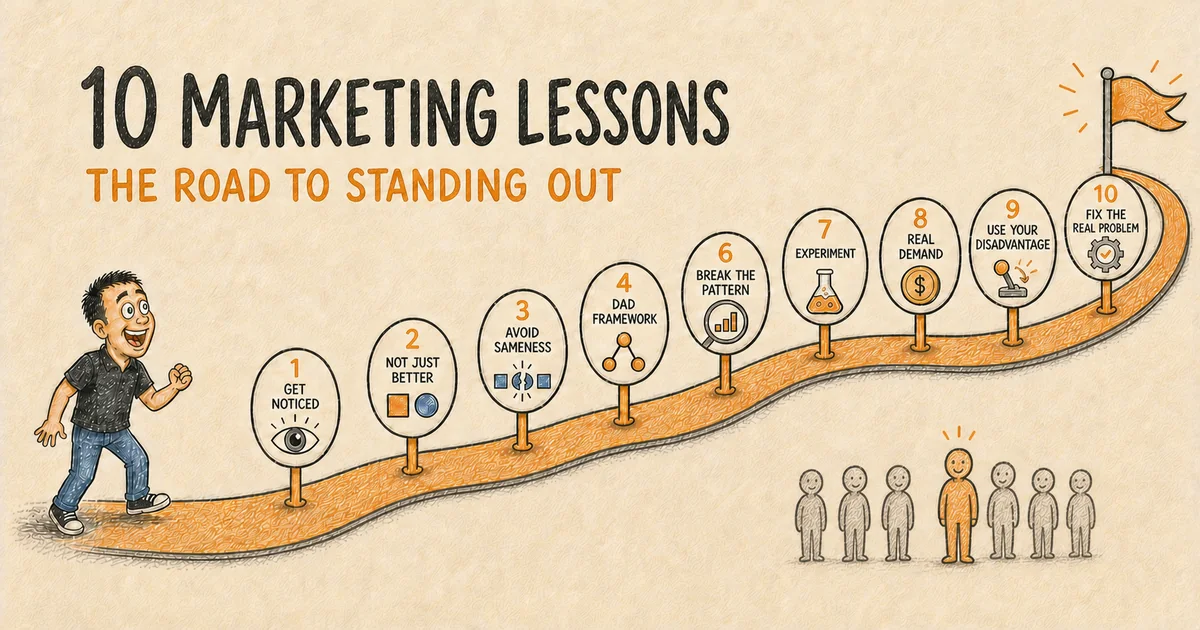
Here are 10 marketing lessons I use when I want a business to stand out, attract the right people and turn attention into action.
1. If nobody notices you, nothing else matters
 Most businesses assume that customers are actively comparing their offers. In reality, customers are usually distracted, busy and exposed to more marketing messages than they can remember.
Before customers can evaluate your price, features or promises, something has to make them stop and pay attention.
Businesses spend a lot of time improving landing pages, conversion rates, advertisements and funnels.
But there’s a step before all of that:
Did the customer even notice you?
You can have the best offer in the market, but it won’t matter if it looks exactly like the other 20 offers your customer saw today.
Attention doesn’t guarantee a sale. But without attention, you don’t even get the opportunity to make one.
Liquid Death sells something extremely ordinary: water. Instead of using the peaceful mountains, blue labels and wellness language common in the category, it packages water in tall cans and gives it the personality of an aggressive entertainment brand. You can see the positioning directly in its product presentation. The product is simple, but the brand is difficult to confuse with another water company.
2. Better isn’t always better
 Improvement feels like the safest way to compete. If another company has a good product, the obvious response is to create something faster, cheaper or slightly more advanced.
The difficulty is that small improvements are often important to the business but almost invisible to the customer.
When businesses analyze their competitors, they usually ask:
How can we do this better?
A better website. Better content. Better features. Better prices.
Those improvements can be useful, but they don’t always make the business easier to remember. Customers may not notice a company that is 10% better, especially when every competitor makes the same promise.
Sometimes the more valuable question is:
How can we do this differently?
Apple didn’t build its identity around having slightly better technical specifications. Its “Think Different” positioning connected the brand with creativity, independence and people who challenge conventions. Apple still uses that idea as part of its identity, as shown in this official retrospective on thinking differently.
3. Best practices can become a trap
 Following best practices can reduce mistakes and save time. They give businesses a proven structure instead of forcing them to invent everything from the beginning.
But a proven structure gradually loses its power when every competitor begins using it. What once felt effective starts to feel predictable.
Best practices are useful because they show us what has worked before.
But when everyone follows the same best practices, they create a pattern:
- The same website layouts
- The same stock photographs
- The same calls to action
- The same email subject lines
- The same social media posts
What initially improved performance eventually becomes invisible because the customer has seen it too many times.
Use best practices as a starting point, not as rules that can never be challenged.
When Dollar Shave Club introduced itself, it didn’t use the polished, serious style traditionally associated with razor advertising. Its launch video was direct, inexpensive-looking and deliberately funny. You can still watch the original Dollar Shave Club video and see how clearly it breaks the category’s usual advertising pattern.
4. Different isn’t enough
 It is possible to create marketing that gets attention and still produces no meaningful result. People may laugh, share it with friends and forget which company created it five minutes later.
Difference becomes valuable only when it attracts the right people and connects their attention to a clear next step.
Being different can attract attention, but attention by itself doesn’t build a business.
I use a simple three-part framework:
Differentiate → Attract → Direct
- Differentiate: Give people a reason to stop.
- Attract: Make sure the message is relevant to the right customer.
- Direct: Tell that customer what to do next.
A strange advertisement might get thousands of views. But if viewers don’t understand what is being sold or what action they should take, that attention has very little commercial value.
Duolingo uses an exaggerated and sometimes chaotic version of its owl mascot to attract attention. But the jokes usually remain connected to language learning and the consequences of missing a lesson. Its “Learn Korean or Else” campaign with Netflix is a good example: the campaign is funny and unusual, but it still directs people toward learning Korean in the Duolingo app.
5. Know exactly who you want to attract
 Many businesses describe their ideal customer as anyone who might need the product. This creates a large potential market, but it also produces generic marketing.
A message becomes much more persuasive when the customer feels that it was created for someone exactly like them.
Marketing becomes weak when it tries to appeal to everyone.
If you’re speaking to small businesses, multinational companies, beginners and experts at the same time, your message will probably be too broad to feel personally relevant to any of them.
Start with a specific group of people you would genuinely like to serve. A useful exercise is to create a list of 100 ideal customers.
Then ask:
- What do these people already buy?
- What problems do they repeatedly mention?
- Where do they spend their time?
- What kind of language do they use?
- What would make them immediately feel that an offer was designed for them?
Rolls-Royce Motor Cars doesn’t design its message for every person looking to buy a car. Its Bespoke program is created for a relatively small group of customers who value exclusivity, personalization and craftsmanship. The narrower audience allows the company to make the product and its message far more specific.
6. Find the pattern before trying to break it
 Trying to look different without understanding the market often produces something random rather than useful. The result may attract attention, but it can also confuse the people you want to reach.
Effective differentiation begins with observation. You first need to understand what customers have learned to expect from your category.
Study your market and identify the common patterns:
- What colors does everyone use?
- What promises do they make?
- What does their advertising sound like?
- How do they describe the problem?
- What does their buying process look like?
Once the pattern is clear, decide which part can be changed without making the offer confusing.
The goal isn’t to be random. The goal is to create a meaningful contrast.
Oatly entered a category filled with clean, careful and health-focused packaging. Its cartons used conversational writing, unusual typography and a playful tone. It still looked like a food product, but it didn’t sound like the other products beside it. The company explains more about its identity and unusual approach on its official “Who We Are” page.
7. Treat marketing like an experiment
 Marketing discussions can easily become battles between personal opinions. One person likes a headline, another dislikes the color and someone else wants to copy a competitor.
Instead of trying to predict the perfect answer in a meeting, create a small test and let customer behavior provide the answer.
A new marketing idea doesn’t need to begin as a large, expensive campaign.
Start with a small experiment:
- Choose one specific audience.
- Create one different message or presentation.
- Decide what result you want to measure.
- Run the test on a limited scale.
- Keep, improve or discard the idea based on the result.
This makes it easier to try bold ideas without putting the entire business at risk.
Booking.com is known for using experimentation to evaluate changes to its digital products. Instead of relying entirely on internal opinions about what customers might prefer, teams can test alternatives and observe what users actually do. Its engineers and researchers have published material about experimentation, including this paper on online experimentation at Booking.com.
8. Trust wallets more than words
 Positive feedback feels encouraging, especially when you are developing a new idea. Unfortunately, people can sincerely like an idea without wanting it enough to buy it.
The difference between interest and demand only becomes visible when someone has to make a real commitment.
People are often polite when you ask what they think about an idea.
They might tell you:
“That sounds great.”
“I would definitely use that.”
“You should launch it.”
But compliments aren’t demand.
A stronger signal is a meaningful action: a deposit, preorder, paid trial, booked consultation or signed agreement.
Pebble used Kickstarter to let customers financially support its smartwatch before a traditional retail launch. Its Pebble Time campaign attracted tens of thousands of paying backers and raised more than $20 million. The pledges provided a much stronger signal than a survey in which people simply said they liked the product.
9. Your disadvantage might be your advantage
 When comparing ourselves with larger competitors, it is natural to focus on everything they have that we don’t: larger teams, bigger budgets, more customers and greater brand recognition.
But trying to behave like a smaller version of a large company can hide the qualities that make a smaller business attractive in the first place.
A perceived weakness can sometimes become a powerful position.
- A small company can offer direct access to the founder.
- A local business can understand its community better.
- A newcomer can challenge habits that established companies no longer question.
- A simpler product can be easier to understand and use.
Don’t automatically copy the strengths of a larger competitor. Look at what your situation allows you to do that the competitor cannot easily reproduce.
Avis famously used its position behind the market leader to create the “We Try Harder” message. Second place became a reason to expect more effort and better service. Avis still presents the idea on its official “We Try Harder” page.
10. Sometimes marketing isn’t the problem
 Marketing is visible, measurable and relatively easy to change. That makes it a convenient explanation whenever sales are disappointing.
But if people notice the offer and still decide not to buy—or buy once and never return—the problem may be deeper than the campaign.
When sales are disappointing, it’s tempting to change the advertisements, publish more content or rebuild the website.
But marketing can’t permanently compensate for:
- A product people don’t want
- An unclear offer
- A bad customer experience
- A price that doesn’t match the value
- A problem that isn’t important enough
Before creating another campaign, look at the full customer journey.
Are people ignoring the message, or are they noticing it and deciding they don’t want the offer?
Those are two very different problems.
In 1985, Coca-Cola replaced its original formula with New Coke. The company had research showing that people preferred the new taste in tests, but it underestimated their emotional attachment to the original product. After intense customer opposition, the original formula returned only 79 days later. Coca-Cola documents the complete story in its retrospective, “New Coke: The Most Memorable Marketing Blunder Ever?” The problem wasn’t a lack of public attention. People noticed the launch—they simply didn’t want the change.
Final thoughts
Good marketing isn’t just about being louder, funnier or more unusual than everyone else.
It’s about creating a difference that the right customer can notice, understand and act on.
Before launching your next campaign, ask yourself:
- What pattern does my market follow?
- What can I change in a meaningful way?
- Who exactly do I want to attract?
- What should they do after I get their attention?
- How can I test the idea before investing heavily?
You don’t need every person to notice you.
You need the right people to notice you, remember you and take the next step.